
Commercial flat roofs do not announce problems. They develop them quietly, underneath the surface, out of sight from anyone on the ground. By the time a leak shows up on a ceiling tile or a drain backs up during a storm, the damage has usually been building for months.
Regular flat roof maintenance is the most cost-effective strategy available to commercial property owners. It protects their roofing investment and avoids the kind of surprise repair bills that derail capital budgets. After 40 years of servicing commercial roofing systems across the Treasure Coast, Whiting Roofing has seen what consistent maintenance prevents and what deferred maintenance costs. The difference is significant.
A Flat Roof That Goes Without Regular Maintenance Is a Liability
Flat roofing systems are engineered to work as a whole. The membrane, flashing, drains, coatings, and perimeter edge all work together to keep water off the building. When any one component begins to fail, the rest of the system takes on more stress than it was designed to handle.
The problem with flat roofs specifically is that failures are invisible until they are blatant. A membrane seam lifting, a drain slowly restricting, and coatings thinning past effective protection. None of these announce themselves. A flat roof without a maintenance plan is not just an aging asset. It is a structural liability accumulating risk with every passing season.
The Real Cost of Skipping Regular Flat Roof Maintenance
The financial math on deferred maintenance always works against the property owner.
- A clogged drain leads to ponding water that degrades the membrane across a large area. Clearing the drain during maintenance costs almost nothing. The membrane repair it would have prevented costs significantly more.
- A flashing failure at an HVAC curb allows moisture into the insulation below. Replacement of saturated insulation costs far more than the sealant touch-up that would have kept the flashing watertight.
- A roof coating that has thinned past its effective threshold goes unidentified. The membrane beneath it deteriorates through a full South Florida summer before anyone knows it needs attention.
Flat roof maintenance prevents costly repairs by catching these items while they are still inexpensive to address. Curious what typically causes this kind of damage in the first place? See our breakdown of common causes of roof damage on commercial properties.
Benefits
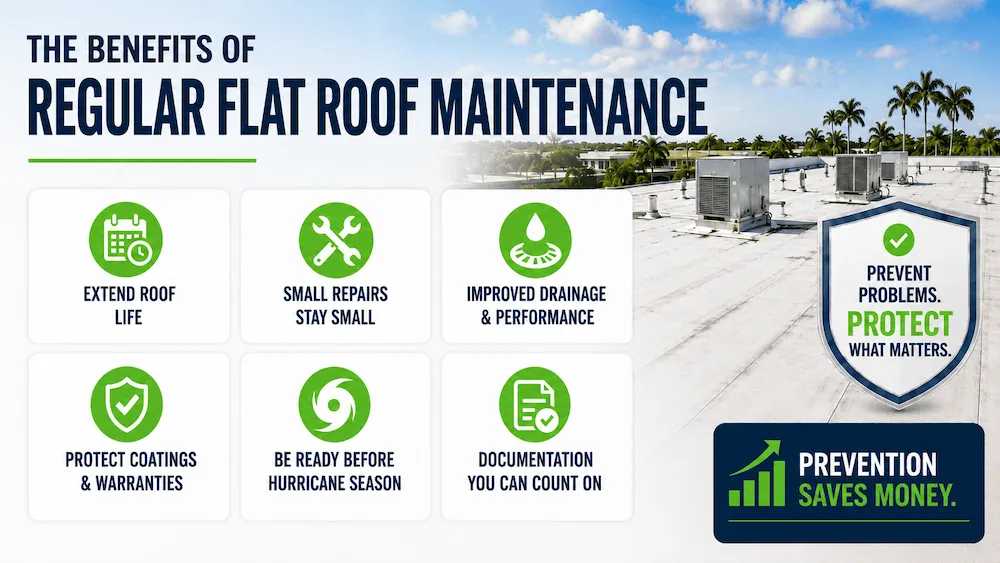
1: You Get the Full Roof Life Out of Your Investment
A commercial flat roof only delivers its intended service life with the right maintenance behind it. Coatings are refreshed before they thin. Seams are sealed before they open. Flashing details are reinforced before they fail.
The cumulative effect of those interventions is a roofing system that reaches and often extends lifespan. The property owners who get the most out of their flat roofing investment treat maintenance as part of the system, not an optional add-on.
2: Small Repairs Stay Small
Every major flat roof repair Whiting has been called in to handle has started as something smaller. A seam that needed sealing. A penetration that needed reseating. A section of coating that needed touch-up.
Left alone, small issues do not stay small. Water finds every weakness. Once inside the roofing system, it degrades insulation, weakens the deck, and creates conditions for further failure. Regular maintenance keeps roof repairs proportionate to what the issue actually is rather than what it will become after being ignored.
3: Drains and Debris are Cleared Before They Cause Damage
Drainage is the single most important performance function of a flat roof. Water that cannot move off the surface sits. Water that sits degrades the membrane and adds structural damage risk to the building below.
What We Check During Every Maintenance Visit:
- We inspect and clear debris accumulated since the last visit
- Scuppers are checked for blockage at the perimeter
- Drainage flow evaluated across the full roof surface
- Low spots identified where water pools between rain events
In South Florida’s summer rain season, a blocked drain can turn a routine afternoon storm into a drainage emergency. Professional roofers clear debris and water pathways regularly so drainage functions at full capacity when it matters most.
4: Your Roof Coating and Manufacturer Warranty Stay Protected
Most commercial roofing manufacturer warranties require documented evidence of regular inspection and upkeep to remain valid. Coatings are particularly dependent on maintenance. A coating system that is not regularly inspected thins unevenly, develops gaps, and eventually fails to protect the membrane beneath it.
Documented Maintenance Protects:
- Manufacturer warranty validity when a claim needs to be filed
- Performance of coatings throughout its intended service life
- Insurance carrier requests for maintenance roof records during storm damage claim reviews
Whiting’s maintenance program provides that documentation automatically. Every visit is recorded, photographed, and stored as part of the property’s service history.
5: You Are Ready Before Hurricane Season Hits
A flat roof that has not been inspected before hurricane season is a roof that will test every weakness it has developed since the last storm.
Pre-Season Maintenance Covers:
- Flashing integrity at every penetration, edge, and wall tie-in
- Condition of coatings across the full roof surface
- Drain and scupper capacity evaluated against storm volume expectations
- Perimeter edges inspected for metal deterioration that reduces wind uplift resistance
After a significant weather event, Whiting maintenance customers receive priority response for post-storm inspections so damage is documented quickly and repairs are initiated before issues compound.
6: You Have Documentation When Insurance Needs It
Florida’s property insurance market scrutinizes roof age, condition, and maintenance history when underwriting policies and reviewing claims. A commercial roof without documentation is difficult to defend.
When Documentation Matters Most:
- At policy renewal: Insurers may request evidence of maintenance when evaluating coverage terms
- During a claim: A documented maintenance history supports the argument that damage was caused by a covered event
- At ownership transfer: Buyers and lenders want to see how a commercial roof has been maintained
Every Whiting visit produces a written report with before-and-after photos, a condition rating, remaining service life estimate, and repair recommendations with pricing.
7: Roof Inspections Tell You What Is Coming Before It Surprises You
Property managers and building owners on a Whiting maintenance plan know the condition of their roof after every visit. That visibility has direct financial value.
Every Whiting Inspection Report Includes:
- Before-and-after photos of the full roof surface and all work completed
- Condition rating that gives ownership a clear picture
- Remaining service life estimate for capital planning
- Repair recommendations with pricing for anything outside the maintenance scope
Commercial roof inspections are not just about finding problems. They are about giving property owners the information they need to make decisions before a failure makes those decisions for them.
How Flat Roof Maintenance Differs by System Type
Flat roof maintenance is not a one-size-fits-all process. Whiting services every major flat roofing system found on commercial properties across South Florida. If your building has a metal roof instead, maintenance needs differ, see our guide to metal roofing maintenance.
SPF Spray Polyurethane Foam
The protective coatings over an SPF roof must be maintained at the correct thickness to prevent UV degradation of the foam beneath it. Whiting is certified with NCFI Polyurethane and brings decades of SPF-specific maintenance experience to every visit.
TPO Roofing
TPO maintenance focuses on seam integrity, flashing conditions, and surface cleanliness. Debris accumulation holds moisture against the membrane and accelerates deterioration. Regular inspection of field seams and termination bars is essential.
Built-Up Roofing
BUR systems require assessment of surface layer condition, blister development, and flashing integrity. Blisters left unaddressed allow moisture beneath the membrane plies and create conditions for widespread delamination.
Coating Systems
Roof coatings must be maintained at the correct mil thickness to perform as intended. Whiting is certified with Tropical Roofing Products. Maintenance visits include surface assessment and touch-up application to restore coverage before the substrate is exposed.
How Often Should a Commercial Flat Roof Be Maintained?
Most commercial flat roofs in South Florida should be inspected at least once per year. Higher-risk properties often need semi-annual flat roof maintenance, especially before and after hurricane season.
More frequent roofing inspections may be needed when a building has heavy rooftop equipment, repeated tenant complaints, prior leak history, coatings, older membranes, or drainage problems. A flat roof should also be inspected after major wind, hail, or debris events.
The goal is not to inspect the flat roof after it fails. The goal is to keep a clear record of its condition, fix minor issues early, extend roof life so that the owners have enough time to plan for larger work before it becomes urgent.
When it’s Too Late
Regular roofing maintenance can extend roofing life, prevents leaks, reduce surprise repairs, and keep small problems from becoming expensive ones. But maintenance cannot reverse a roof that has already reached the end of its service life.
If the flat roof membrane has lost integrity across large areas, insulation is saturated, the deck is damaged, or years of patching have made the system impossible to diagnose, maintenance may no longer be the right answer. In those cases, the honest recommendation may be restoration or replacement.
That distinction matters. A good maintenance program should protect flat roofs that still have life left. It should not be used to keep charging for repairs on a roof that needs to come off.
Whiting Roofing’s Commercial Flat Roof Maintenance Programs
Every visit includes a full roofing inspection, preventative maintenance work completed on the spot, and a detailed written report. Three plan options are available:
Basic Annual Plan: One inspection per year, minor repairs included, full digital report
Premium Semi-Annual Plan: Two inspections per year, drain cleaning, coating touch-ups, priority emergency response
Full-Service Plan: Two to three inspections per year, all minor repairs included, annual coating refresh, leak-free guarantee on qualifying properties, discounted labor rates
Schedule Your Flat Roof Inspection Today
Commercial flat roofs without a maintenance plan are accumulating risk with every season they go without inspections. The longer roofing goes without documented care, the more expensive the outcome becomes.
Whiting Roofing has been maintaining flat roofs across South Florida for over 40 years. From Palm Beach County to Brevard County, Charlie and the team bring the certifications, the system-specific expertise, and the contractor experience to keep your roofing investment performing the way it was designed to.