
Most commercial property owners do not think about their roof until water is coming through the ceiling. By that point the damage has usually been developing for months, sometimes years, working its way through the roofing system in ways that were never visible from the ground.
After 40 years of roofing across South Florida, Whiting Roofing has seen every failure mode a commercial roof can develop. Here is an honest look at what we find most often and what it means for the property owners dealing with it.
Most Commercial Roof Damage Does Not Happen All at Once
This is the most important thing to understand about commercial roof damage. It is rarely a single event that causes a roof to fail. It is a combination of factors that accumulate over time, each one making the next problem worse.
A small flashing issue allows moisture into the roofing system. That moisture degrades the insulation below. The degraded insulation reduces the roof’s ability to handle thermal movement. That movement puts stress on seams. A seam opens. Now water has a direct path into the building.
That sequence can take years to develop and be completely invisible until the ceiling stain appears. Proactive inspection is the only way to interrupt that cycle before it runs its full course.
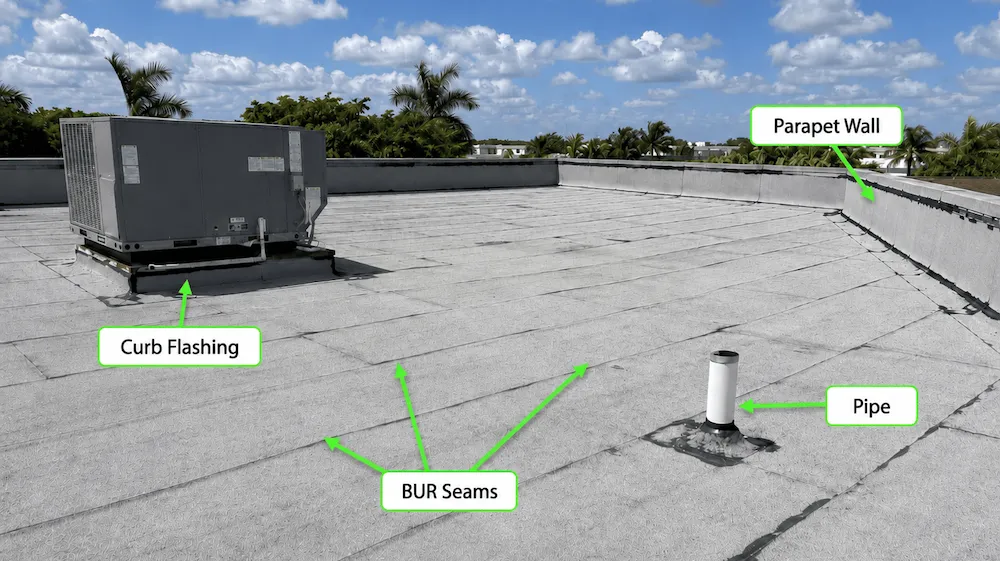
Penetrations Are Where Most Roof Leaks and Water Damage Start
If there is one area of a commercial roof that deserves more attention than any other it is the penetrations.
Common Penetration Points That Fail:
- HVAC curbs and rooftop equipment
- Hood vents and exhaust stacks
- Skylights and roof hatches
- Pipes, conduits, and drains
These transition points are where the membrane must seal against another material. Sealants dry out. Flashing issues develop as metal expands and contracts at a different rate than the roofing membrane. HVAC equipment vibrates and works sealant loose over time.
What We See in the Field
The majority of active roof leaks on commercial properties trace back to a penetration failure. The leak often shows up inside the building far from the actual source because water travels along decking and insulation before finding its way through. By the time it appears on a ceiling tile, it has already done damage between the source and the visible stain.
Drainage Problems That Build Into Serious Roof Damage
Flat and low-slope commercial roofs depend entirely on their drainage systems to move water off the surface. When drains clog or scuppers block, the result is ponding water.
What Ponding Water Does to a Commercial Roof:
- Adds significant weight to the roofing system
- Accelerates membrane deterioration wherever it sits
- Works into any existing weakness in the roof surface
- Creates conditions for biological growth in South Florida’s high humidity environment
Most property owners do not notice drainage problems until leaks and water damage show up inside the building. By that point the roof has been holding water long enough to create problems that go beyond the surface. Drain cleaning during routine maintenance visits is one of the highest-return activities a property owner can invest in.
Seams and Membrane Failures
Seams are the most stress-concentrated areas of any flat or low-slope commercial roof. UV exposure, thermal movement, wind uplift, and water all act on them simultaneously.
Over time seams lift, open, or delaminate. Once a seam is no longer watertight, water has a direct path into the roofing system. The failure often starts small and progresses quickly once water begins cycling in and out with rain events.
Flashing issues follow the same pattern. Flashing at walls, parapets, and penetrations is consistently among the most common repair items on commercial roofs of every age and material type.
Rusted and Failing Edge Metal
The perimeter of a commercial roof is protected by metal edging that seals the roofing membrane at the building edge and directs water off the surface. In South Florida’s humid, salt-influenced environment, edge metal is under constant attack.
Why Edge Metal Fails:
- Moisture and oxidation degrade the metal over time
- Gaps develop where water can work under the roofing membrane
- Wind uplift resistance at the perimeter is compromised
- Rust weakens fasteners that hold the edge system in place
This is a repair item that is often overlooked because it is not visible from the ground and rarely causes an immediate interior leak. But failing edge metal contributes directly to wind damage events and to the slow moisture intrusion that develops at roof perimeters over time.
Age-Related Wear and Tear on Older Roofing Systems
Every roofing system has a service life. In South Florida that service life is compressed by UV intensity, rainfall volume, and the thermal cycling the roof goes through year-round.
What an Aged-Out Commercial Roof Looks Like:
- Surface granules completely worn away on older rolled roofing with fibers already exposed
- Multiple layers of patches and coatings applied over years of deferred maintenance
- Membrane material that has become brittle and will not hold a repair
- Hidden damage beneath the surface that is not visible without moisture testing
One of the most consistent patterns Whiting sees is property owners who have pushed a commercial roof well past its useful life. At that stage the conversation is not about repair. It is about replacement. And the longer that conversation is delayed, the more the building interior is at risk with every rain event.
How Damage Shows Up Differently by Roof Material
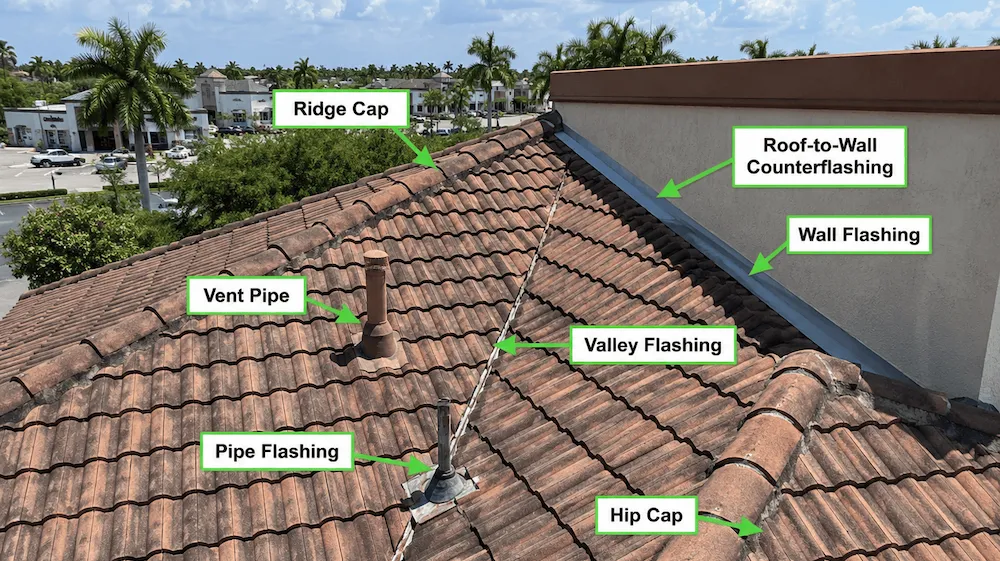
Roof damage does not look the same across every roofing system. Knowing what to look for on your specific material type is what allows property owners to identify problems early.
Shingles
Missing Shingles, Damaged Shingles, and Granule Loss
The most visible signs of damage on a shingle roof is missing shingles, damaged shingles with cracked or curling edges, and granule loss that leaves the underlying mat exposed. Roof valleys are particularly vulnerable because water volume concentrates there and wear is consistently heavier than on open field areas.
Once granule loss is significant the shingles are no longer providing adequate UV protection and deterioration accelerates rapidly.
Tile Roofing
Cracked, Slipped, and Broken Tiles
Tile roofs are durable when properly maintained but cracked, slipped, or broken tiles create immediate vulnerability. The tile itself does not waterproof the roof. The underlayment beneath it does. When tiles are displaced the underlayment is exposed to direct UV and rainfall. Once it degrades, water intrusion follows quickly.
Metal Roofing
Wind Damage, Rust, and Fastener Failure
Metal has specific failure modes that require consistent attention:
- Wind damage can lift panels at seams and edges where fasteners have begun to back out or corrode
- Rust is a consistent problem on neglected metal roofs in coastal environments
- Tree damage from branches dragged across a metal surface during storms compromises the finish and accelerates oxidation
- Seam separation allows water into the building without obvious surface damage
Hail Damage and What It Does to a Commercial Roof
South Florida sees hail less frequently than markets further north but when it occurs the damage is significant and often not immediately visible.
How Hail Affects Different Roofing Systems:
- Shingles: Hail bruises the granule surface and accelerates deterioration from the impact point forward. No immediate leak but the remaining service life of affected shingles is shortened considerably.
- Membrane roofing: Punctures or bruising that are difficult to identify without a professional inspection.
- Metal: Impact dents that compromise the finish and create stress points at the surface coating.
Hail damage is one of the most commonly missed causes of roof problems because the connection between a hail event and a leak that develops months later is not obvious to a property owner. If your property experienced significant hail, a professional inspection is the only reliable way to assess the impact.
Roof Material Failure From Bad Installation
Not all roof damage traces back to age or weather. A significant portion of the commercial roof failures Whiting diagnoses across South Florida trace back to how the roof was installed in the first place.
What Bad Installation Looks Like Years Later:
- Wrong roof materials for the climate or building type
- SPF roofing systems applied without correct substrate preparation
- Flashing installation that does not integrate properly with the roof membrane
- Coating systems applied at the wrong mil thickness
- Drainage layouts that cannot handle South Florida’s rain volume
These problems do not show up on installation day. They show up years later as chronic roof leaks that another contractor is called in to diagnose. The challenge is that installation-related failures are often misread as maintenance failures. A property owner who has been doing everything right finds themselves dealing with recurring problems that no repair seems to fix permanently.
Waiting Too Long to Replace
This is one of the most financially damaging patterns Whiting encounters on commercial properties throughout the region.
A property owner knows the roof has age-related wear and tear. Repairs have been increasing in frequency. Each one buys a little more time. The replacement conversation keeps getting pushed because the budget is not there or the timing is not right.
Meanwhile:
- Roof repair costs accumulate
- The roofing system continues to deteriorate
- Interior damage begins to develop
- When replacement finally cannot be avoided the scope is larger and more expensive than it would have been years earlier
Failing commercial roofs often have leaks in more than one area by the time a property owner decides to act. The problem is rarely one bad spot. It is the full roofing system reaching the end of its useful life across multiple areas simultaneously.
Maintenance is Important for Warranties
Commercial roof warranties do not remove the need for roof maintenance. In many cases, manufacturers expect property owners to keep the roof clean, maintain drainage, address small issues promptly, and document inspections or roof repairs.
That matters when a roof problem develops. Regular inspections, drain cleaning, photo reports, and repair records create a clear history of how the roof was cared for over time.
When Roof Repairs Are the Wrong Answer
Budget pressure is a real constraint for commercial property owners. The instinct to repair rather than replace when money is tight is understandable. But there are situations where repair is genuinely the wrong answer.
Signs That Replacement Is the Honest Next Step:
- Hidden structural damage beneath the surface that repair cannot address
- A roof membrane that has lost integrity across multiple areas simultaneously
- Accumulated layers of patches and coatings that make the system impossible to diagnose reliably
- Repair costs that are approaching or exceeding what replacement would cost
Charlie’s approach at Whiting is direct. When the roof needs to come off, he says so. When repair is the right investment, he will tell you that too. That honesty is what commercial property owners across South Florida have relied on for over 40 years.
What South Florida's Climate Does to Every One of These Problems
Every failure mode in this blog is made worse by South Florida’s climate. That is not an exaggeration. It is the practical reality of roofing in one of the most demanding environments in the country.
The Conditions That Accelerate Every Problem:
- Humidity accelerates the deterioration of sealants, roofing membranes, and flashing materials year-round
- UV intensity breaks down roofing materials faster here than almost any other market in the country
- Summer rain season delivers water volume that exposes every drainage weakness and penetration failure simultaneously
- Hurricane season introduces wind, debris, and sustained water exposure that tests every aspect of a roofing system at once
A small seam issue that might take years to become a leak in a northern market can become an active problem within a single rain season in South Florida. Proactive roof repair and maintenance are not optional here. They are what the conditions demand.
How Whiting Roofing Assesses Commercial Roof Damage
When Whiting inspects a commercial roof the assessment goes beyond the visible surface. Charlie and the team look for the underlying cause of every problem, not just the symptom that brought them to the property.
What Every Whiting Inspection Covers:
- Moisture testing to identify water beneath the surface
- Flashing inspection at every penetration and transition point
- Drainage evaluation across all drains, scuppers, and perimeter systems
- Full surface condition assessment by material type
- Written report with before and after photos, condition rating, and honest repair versus replacement recommendations
If your roof is not actively leaking but has not been inspected recently, regular maintenance may be the best next step. A maintenance plan is beneficial to help document the roof’s condition, address minor issues early, and give ownership a clearer picture of future repair or replacement needs.
Whiting has been making those assessments across commercial properties from Palm Beach County to Brevard County for over 40 years. If your commercial roof is showing signs of damage or has not been inspected recently, the most valuable next step is a professional assessment from a roofing team that knows South Florida’s conditions and will tell you exactly what the roof needs.