
Metal roofing is one of the most durable exterior systems available for both residential and commercial properties. It handles wind, rain, and UV exposure better than most alternatives. And in South Florida’s climate, that durability matters. But metal roofing is not maintenance-free. The properties that get the most out of a metal roof are the ones where the roof is checked regularly, cleaned properly, and serviced before small issues become expensive ones.
Whether you own a home with a standing seam metal roof or manage a commercial building with exposed fastener panels, the maintenance principles are the same. Stay ahead of potential issues, and your roof will perform for decades. Let maintenance falter, and the problems that develop are rarely simple or inexpensive to correct.
A Metal Roof Is Only as Good as the Maintenance Behind It
Metal roofing gets a reputation for being bulletproof. In some ways that reputation is well earned. A properly installed metal roof with quality panels, correct fasteners, and the right accessories will outlast most other roofing systems available.
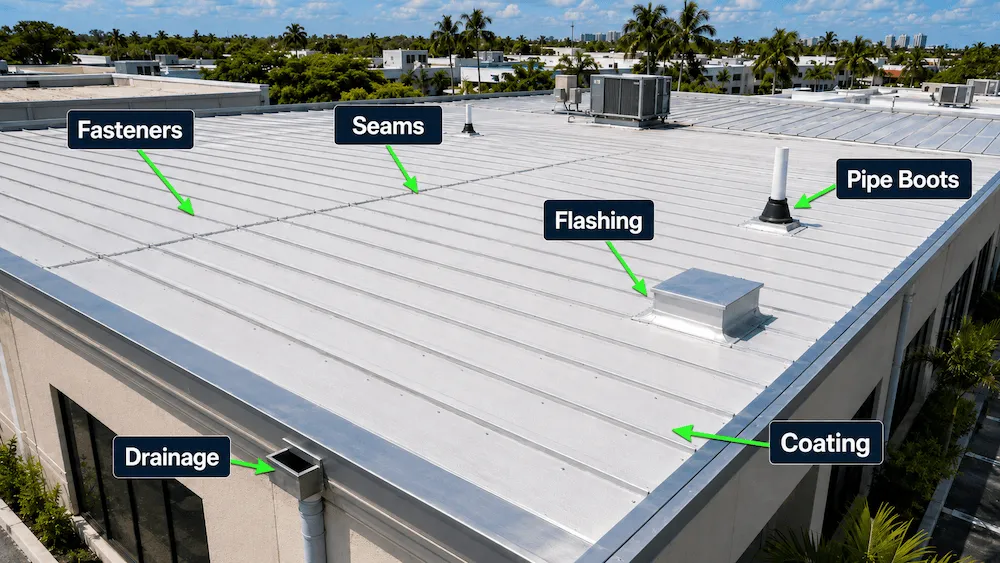
The problem is that most of what causes a metal roof to fail prematurely has nothing to do with the panels themselves. Fasteners back out. Seals around penetrations dries and cracks. Gutters fill with debris and hold water against the roof edge. Coatings fade and chalk past the point of effective protection. Pipe boots deteriorate. None of these are panel failures. All of them are maintenance failures that show up as roof damage years after a straightforward intervention would have prevented them.
Metal roof maintenance is not about fixing the metal. It is about keeping everything around and underneath the metal panels performing the way it was designed to.
What Whiting Sees on Neglected Metal Roofs Across South Florida
After 40 years of roofing across the Treasure Coast, Whiting’s team has inspected enough neglected metal roofs to know exactly what deferred maintenance looks like.
The Most Common Issues Found on Inspection:
- Fasteners that have backed out or whose rubber washers have dried and cracked, creating leak paths at every affected screw hole
- Failures of seals at penetrations, ridge caps, and trim details that have gone unaddressed for years
- Development of rust at cut edges, scratches, and any point where the protective coating has been compromised
- Biological growth, algae, and surface buildup on panels under tree coverage that has never been cleaned
- Gutters packed with debris that are holding moisture against the roof edge and fascia
- Coating systems that have chalked and faded past the point where the metal beneath them has meaningful UV protection
- Paint overspray on panels and trim from nearby exterior work that was never properly removed
These are not catastrophic failures. Every one of them starts as a maintenance item and becomes a repair or replacement conversation when it is not addressed.
How South Florida’s Climate Affects Your Roof Differently
Metal roofing in South Florida faces conditions that accelerate every failure mode on the list above. UV intensity here is among the highest in the country, and it breaks down seals on metal roof panels and pipe boot rubber faster than in milder markets. High humidity creates ideal conditions for biological growth and corrosion at any point where the protective coating has been compromised.
South Florida’s thermal cycling is also more pronounced than most property owners realize. Metal panels expand and contract with temperature changes, and in a climate where surface temperatures can swing dramatically between a summer afternoon and a cool winter morning, that movement is constant. Over time that movement works fasteners loose, stresses sealant joints, and opens gaps at trim and flashing details.
Storms add another layer of stress to your roof. Wind-driven debris scratches panel surfaces and compromises finishes at impact points. Water infiltration during storms finds every weakness in a fastener seal or sealant joint that routine maintenance would have caught and corrected.
How to Clean a Metal Roof the Right Way
Maintenance tips on how to clean a metal roof is one of the most common questions Whiting receives from homeowners. Your roof panels start to look dingy after a few years, particularly on properties with significant tree coverage where sap, algae, and biological growth accumulate on the surface.
What Works and What Does Not
Cleaning a metal roof correctly means using low-pressure washing with appropriate solutions designed for metal roofing surfaces. The goal is to remove biological growth, sap, and surface buildup without damaging the panel finish.
Do not use bleach. Bleach can damage metal roofing seals and accelerate corrosion at any point where it contacts bare metal. It is one of the most commonly asked-about methods and one of the most consistently wrong answers for metal roofing surfaces.
Do not use high-pressure washing. High pressure can force water under panel laps, damage sealant details, and compromise the finish on older panels. It can also drive water into fastener holes on exposed fastener roofs.
Routine Metal Roof Maintenance Cleaning Covers:
- Low-pressure washing with metal-safe solutions
- Removal of debris from valleys, gutters, and any areas where buildup concentrates
- Clearing gutter systems to ensure drainage is clear and water is moving away from the roof edge
- Inspection of the panel surface for scratches, rusted areas, or finish damage that needs to be addressed
For properties with significant tree coverage, annual or semi-annual roof cleaning is the most effective way to keep biological growth from becoming a surface damage problem.
Fastener Failures: The Most Common Roof Repair on Metal Roofs
On exposed fastener metal roofing, fasteners are both the most important component and the most common maintenance item. Every screw that penetrates the panel creates a potential entry point for water. When the fastener seal is working correctly, that entry point is protected. When it is not, water gets in with every rain event.
How Fastener Failures Develop:
- Rubber washers on exposed fasteners dry out and crack over time, losing their watertight seal
- Fasteners back out as panels move through thermal expansion and contraction cycles
- Undersized screws loosen faster because they have less thread engagement in the substrate
- Overdriving them during installation crushes the washer and compromises the seal from day one
The result is a roof that leaks at dozens or hundreds of fastener locations simultaneously, each one a small entry point that collectively creates significant water intrusion across the full panel field.
What Fastener Maintenance Involves
On older exposed fastener roofs where fasteners have backed out or washers have failed, the right approach depends on the extent of the problem. Targeted replacement of failed fasteners with correctly sized screws and fresh washers can restore the seal on a roof where the panels themselves are still in good condition. In some cases screw replacement across the full roof is a more cost-effective solution than replacement of the roofing system itself.
Check your fasteners regularly. It is one of the highest-return maintenance activities on an exposed fastener metal roof and one of the most consistently overlooked.
Why Poor Installation Creates Long-Term Maintenance Headaches
A significant portion of the metal roof repair calls Whiting receives are not maintenance failures. They are failures from improper install that took years to show up.
Common Installation Problems That Create Long-Term Issues:
- Standing seam roofs with exposed fasteners at trim and transition details where proper hemming or locking details should have been used
- Missing closures at eaves and ridges that allow moisture, insects, and debris to enter the panel cavity
- Pipe boot installation that was never properly sealed or used the wrong boot size for the penetration
- Ridge vent details that were undersized or improperly sealed, allowing water infiltration at the highest point of the roof
- Trim and flashing details that were caulked instead of properly formed and lapped
These problems look like maintenance issues when they show up. In reality they are the result of installation shortcuts taken years earlier. A proper inspection identifies which problems are age and wear-related and which ones trace back to how the roof was put together in the first place. That distinction matters because the right repair approach is different in each case.
Roof Coatings: The Most Powerful Tool for Metal Roof Maintenance
For commercial properties with aging metal roofs, roof coatings represent one of the most cost-effective maintenance and restoration strategies available. A quality coating system applied to a metal roof that still has structural integrity can extend the service life of that roof significantly, restore reflectivity that has been lost to chalking and fading, and provide a new waterproof layer over fasteners, seams, and penetrations that have been showing age.
Whiting is certified with Tropical Roofing Products for coating applications on metal roofing. That certification matters because coating a metal roof correctly requires proper surface preparation, the right primer for the substrate, and application at the correct mil thickness. A coating applied incorrectly will peel, fail prematurely, and leave the property owner with a worse situation than they started with.
A Metal Roof Coating Addresses:
- Fastener heads and seams embedded and sealed within the coating system
- Reflectivity restored to reduce thermal load on the building
- A new waterproof layer over the full panel surface
- Protection for any areas where the original finish has been compromised by chalking, fading, or minor damage
For commercial property owners who are facing a replacement conversation on a metal roof that still has good bones, a coating system is often the right answer before committing to the cost and disruption of full replacement.
Maintenance Tips for Standing Seam vs. Exposed Fastener
The two most common metal roofing styles found on South Florida properties have different maintenance priorities. Understanding which system you have and what it requires is the starting point for effective roof maintenance.
Standing Seam
Standing seam panels connect through a concealed locking mechanism that eliminates exposed fasteners in the field. This makes standing seam one of the more durable metal roofing options from a long-term maintenance standpoint. The primary maintenance focus areas are:
- Seam integrity at panel connections and any areas where the lock has been compromised
- Flashing and trim details at eaves, rakes, ridges, and penetrations where exposed fasteners are still used
- Seals at all transition points and penetrations
- Coating and finish condition across the panel surface
- Drainage performance at the eave where water exits the roof
Exposed Fastener Panels
Exposed fastener systems require more frequent attention to fastener condition than standing seam. Roof maintenance includes:
- Full fastener check across the panel field and at all trim and flashing details
- Washer condition assessment and replacement of any fasteners showing backing-out or washer failure
- Inspection of seals at all penetrations, ridge caps, and closure details
- Panel surface inspection for scratches, corrosion, and any areas where the finish has been compromised
- Clean gutters to prevent rain backup at the eave
Yearly Maintenance Cost or Deferred Care
A yearly maintenance inspection and service visit catches fastener failures before they become interior leaks. It identifies coating breakdown before the metal beneath is exposed to accelerated corrosion. It clears gutters before rainwater backs up against the roof edge through an entire rain season. It finds seal failures at penetrations before water has cycled in and out through dozens of rain events.
Every one of those items is inexpensive to address during a scheduled visit. Every one of them becomes significantly more expensive after a year or two of moisture infiltration has been allowed to work on the surrounding materials.
The maintenance cost of annual or semi-annual care is a fraction of what the repairs it prevents would cost. Over the life of a metal roof the savings are substantial.
For a broader look at how routine inspections protect commercial roofing systems, read our guide on the benefits of regular flat roof maintenance.
What a Professional Metal Roof Maintenance Visit Covers
A Whiting metal roof inspection covers the full system of your roof, not just the panels.
Metal Roof Maintenance Included in Every Visit:
- Full panel surface inspection for damage, finish deterioration, rusted area development, and biological growth
- Fastener check across the full roof field on exposed fastener systems
- Inspection of seals at all penetrations, trim details, pipe boots, and ridge and eave transitions
- Flashing and closure condition assessment
- Clean gutters and drainage evaluation
- Cleaning where biological growth or debris buildup requires it
- Minor roof repairs addressed on the spot within the maintenance scope
- Written report with before and after photos, condition rating, and repair recommendations
For commercial properties, Whiting’s roofing maintenance program offers annual and semi-annual plan options with minor repair included, priority emergency response, and detailed reporting after every visit.
Schedule Your Metal Roof Inspection With Whiting Roofing
A metal roof that is properly maintained will outperform almost any other roofing system available. One that goes without attention will develop problems that are entirely preventable and increasingly expensive the longer they are left alone.
Whiting Roofing has been maintaining metal roofs across South Florida for over 40 years. From residential standing seam to large-scale commercial panel systems, Charlie and the team bring the field experience, the certifications, and the honest assessment that metal roof owners across the Treasure Coast have relied on for decades.